

Rug Guides · 21 Oct 2026
Rug Trends 2026: The Looks Designers Are Choosing Now
Earthy colour, tactile texture, folk patterns and a confident return to saturated shades. These are the rug looks shaping homes in 2026.
Rug Guides · 21 October 2026 · 3 min read
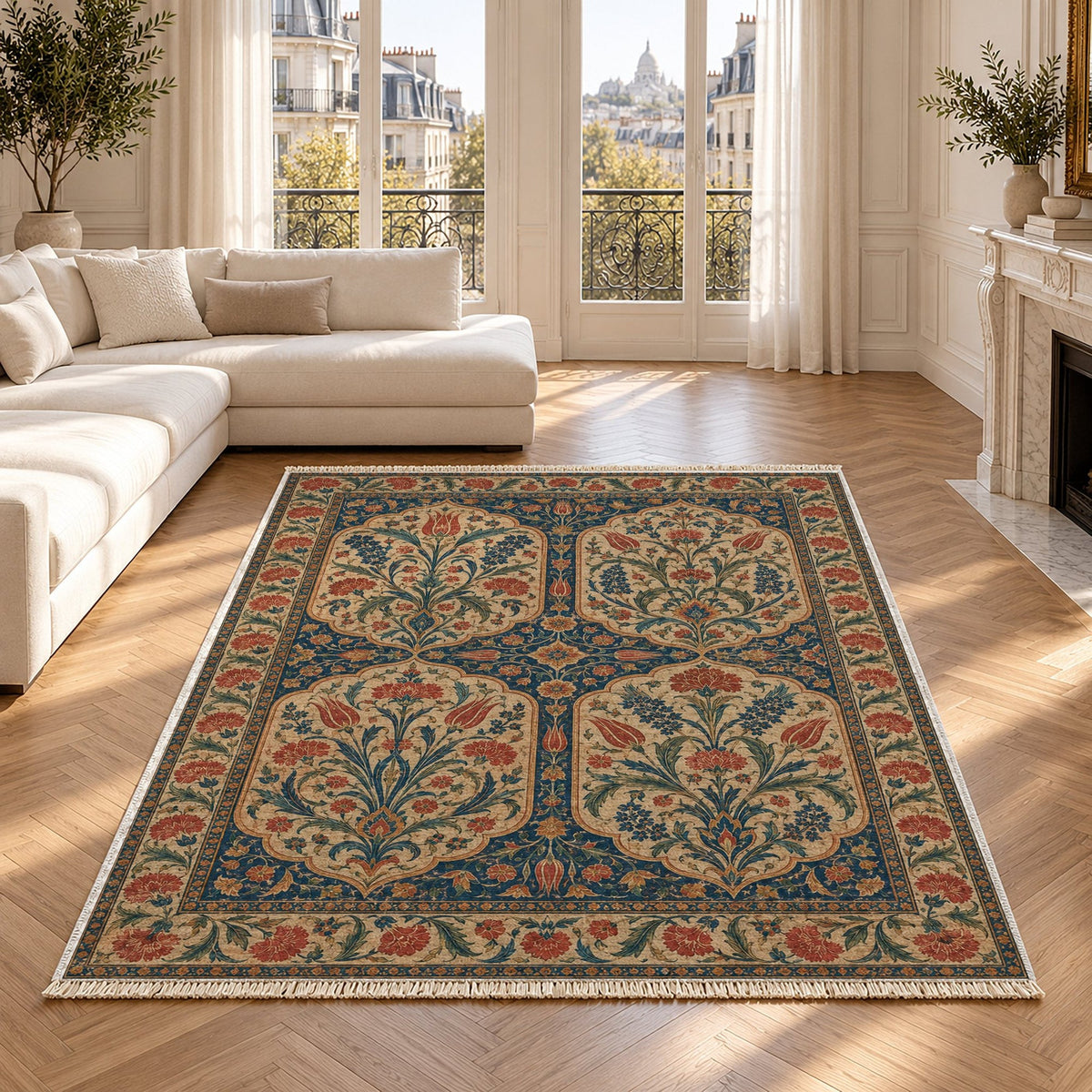
Geometry used to shout. A decade ago the go-to geometric rug was a crisp black-and-white chevron, a monochrome hexagon or a zigzag so sharp it seemed to vibrate. Those designs had energy, but they could dominate a room and date quickly. Trend forecasters now expect softer geometrics to replace hard, high-contrast ones, and the change is already visible: lines are fading, edges are wobbling, colours are warming and geometry is merging with traditional and floral motifs. Here is what defines the new look, how to style it, where it works best and four designs that capture it.
The high-contrast geometrics of the 2010s belonged to a cooler era of interiors: white walls, grey sofas and chrome. As homes move towards warmer, earthier palettes, olive, terracotta, mocha and sage, hard monochrome patterns can feel out of step.
Softer geometry keeps the structure people love about pattern, the order and rhythm, but removes the glare. It is pattern you can live with every day rather than pattern that demands attention, and it sits comfortably alongside the current taste for mixing eras and styles in one room.

Softer geometry is surprisingly flexible. These approaches work well:
Geometry brings order, so it shines where a room needs structure. In hallways, a repeating pattern on a runner leads the eye to the far end and makes a narrow space feel purposeful; see our runner rugs. In dining rooms, a grid or tile design frames the table. In open-plan spaces, a geometric design can define the living zone clearly without walls. And outside, a lattice flatweave turns a patio into an outdoor room.

Scale matters more than style. In a small room, a large, calm motif often looks more restful than a tight, busy one. In a big room, a small repeat can read as texture from a distance. As a guide, a terrace living room usually needs 155×230 cm or 160×230 cm, while larger rooms take 200×300 cm. Make sure the pattern's border or repeat is not cut off awkwardly by furniture.
 Tile Pavilion Indigo & Rust Ottoman Washable RugMade to order · 10 sizes · machine washableFrom£50
 Faded Grid Ivory & Taupe Abstract Washable RugMade to order · 10 sizes · machine washableFrom£50
 Lotus Stair Peacock & Ochre Persian Washable RugMade to order · 10 sizes · machine washableFrom£50
 Natural Lattice Flatweave Indoor Outdoor RugLondon stock · ready to shipFrom£29
Indigo and rust in an Ottoman tile design where floral and geometric motifs meet: geometry at its warmest. Ideal for a dining room with dark timber. Machine washable at 30°C, made to order in 10 sizes from £50.
A faded taupe grid on ivory, the purest expression of soft geometry here. It suits a contemporary living room with curved furniture and plenty of texture.
Peacock blue, ochre and brown in a Persian-inspired design with stepped geometric structure. It brings richness to a hallway as a runner or to a snug with deep-coloured walls.
A natural beige and brown lattice with a rustic, farmhouse feel, for kitchens, conservatories or the patio. It is a washable 100% polypropylene flatweave of about 4 mm, from £29, dispatched from our Enfield warehouse within 1–2 business days.
Yes, but the look has changed. Softer, lower-contrast and hand-drawn geometrics are replacing the sharp black-and-white patterns of the 2010s.
Plain, textured upholstery, curved furniture and one or two accessories that repeat a colour from the rug. Natural wood and plants soften the look further.
Yes. Keep one pattern dominant, vary the scale, and make sure the two share at least one colour so they look intentional.
The new geometry is calmer, warmer and easier to live with. Explore our full range of geometric rugs to find a pattern with structure but no glare.
Rug Guides · 21 Oct 2026
Earthy colour, tactile texture, folk patterns and a confident return to saturated shades. These are the rug looks shaping homes in 2026.
Rug Guides · 21 Oct 2026
From Tudor portraits to Victorian parlours, Turkish carpets have shaped Western rooms for centuries. Here is the story behind the motifs, and...
Rug Guides · 21 Oct 2026
Buying a rug you have never touched can feel risky. Measure properly, read the listing closely and understand delivery and returns, and...

